


The previous post ended with the iPhone in a very specific state. The boot chain has verified and launched a kernelcache, and XNU, the kernel iOS and macOS share, is now running as the most privileged code on the application processor. That kernelcache is XNU plus every kext (kernel extension: a driver module) the device needs, prelinked into one image and loaded by iBoot.
Everything a process does to the kernel, and everything an exploit does to escalate, converges on one capability: a handle, held in userland, that reads and writes kernel memory. In iOS folklore that handle is called tfp0. Almost every iOS kernel exploit is the same arc toward it: a memory-safety bug, a controlled reallocation, a type confusion into a kernel object, kernel read/write, and a rewritten credential.
Everything here is public: Apple’s open-source XNU, the Apple Platform Security documentation, and published research from Project Zero and others. It contains no exploit, private detail, or 0day.
The Mach and BSD hybrid
XNU is a hybrid, and the word is doing real work. Its core is Mach, which owns inter-process communication, virtual memory, and scheduling. The other half is a BSD personality, which owns the POSIX (standard Unix) surface: processes, the syscall table, the filesystem layer, sockets, and credentials. IOKit, the C++ driver runtime covered in a later post, rounds it out. All of it is linked into a single image, the kernelcache, running in one privileged address space at EL1, the kernel’s privilege level.
The hybrid is a performance decision. A true microkernel would run BSD and IOKit as separate Mach servers reached by message passing; XNU co-locates them in kernel space and lets them call each other directly.
That decision has a consequence an attacker cares about. There is no internal privilege boundary between these subsystems below the guarded monitors Apple added later: the Page Protection Layer (PPL), then the Secure Page Table Monitor (SPTM), both discussed near the end. A memory-safety bug in a niche IOKit driver or a BSD socket option corrupts the same privileged address space that holds ipc_port objects and, before those monitors, the page tables, so a BSD bug regularly ends up as a Mach primitive.
If you come from Linux, start with two mappings. A Mach port is the exact analogue of a file descriptor. Both are a small integer, valid only inside one process, that indexes a per-process table in the kernel and names a kernel object you never touch directly. You read and write a file through an int; you talk to a service, a task, or a driver through a mach_port_name_t. And like a file descriptor, a port is transferable: you hand a port to another process inside a Mach message, the same way you hand a file descriptor to another process with SCM_RIGHTS over a Unix socket.
A Mach message is the analogue of writing to a socket or pipe, with one difference. It can carry port rights and out-of-line memory, not just bytes, so sending a message can transfer a capability. That is why the rest of iOS security is built on Mach IPC.
Both mappings are rows in a longer correspondence. Many concepts have a Mach half and a BSD half of the same underlying thing:
| Concept | Mach side | BSD side |
|---|---|---|
| The process | task (address space, ports, threads) |
proc (pid, credentials, file descriptors) |
| The thread of execution | thread (the schedulable entity) |
uthread (syscall state) |
| The syscall table | mach_trap_table (negative numbers) |
sysent (positive numbers) |
| The handle to a kernel object | Mach port: mach_port_name_t into ipc_space |
file descriptor: int into p_fd |
| IPC | Mach message (mach_msg) |
sockets, pipes, signals |
| Virtual memory | vm_map, vm_object, pmap (Mach owns it) |
mmap, mprotect (BSD uses it) |
| The security model | capabilities (you can do what you hold) | identity (kauth_cred_t: uid, Mandatory Access Control label) |
A process is both a task and a proc, linked by a back-pointer, and a syscall from EL0, the unprivileged level where app code runs, lands in one of two dispatch tables depending on the sign of the syscall number.
The Mach half
Tasks and threads
A task is a container. It owns an address space (vm_map), a port namespace (ipc_space), a set of threads, and a handful of special ports it starts life with. A thread is the schedulable entity inside a task: it carries register state and its own control port. Both live in dedicated kernel zones (per-type allocator pools) and, on modern hardware, are increasingly kept in memory no other type can reuse, with their pointers signed.
For an attacker the task structure matters because it is the thing you eventually want to forge. A fake task you control, referenced by a port the kernel believes is a task control port, is a fake kernel task port.
Ports and port rights
A Mach port is an object inside the kernel, a struct ipc_port. It is a message queue with an ownership and rights model attached. Userland never sees the object or its address. It sees only a name, a mach_port_name_t, a small integer valid inside the naming task. Everything a task is allowed to do it does by holding the right kind of port.
The authority is not the port, it is the right you hold to it. There are four kinds:
- receive: unique, held by exactly one task, owns the message queue. Whoever holds the receive right is the service behind the port.
- send: a copyable capability to enqueue messages onto that queue.
- send-once: guarantees exactly one message, then is consumed. Reply ports use these.
- dead-name: what a right becomes when its port dies.
The whole capability model is one sentence: the right you hold decides what you are allowed to do.
Most ports front a userland message queue. Some front a kernel object instead, and those are the ones that matter. Their io_bits field carries a kobject type from a fixed set (IKOT_TASK_CONTROL, IKOT_THREAD_CONTROL, IKOT_HOST_PRIV, IKOT_IOKIT_CONNECT), and ip_kobject points at the real kernel object: a task, a thread, an IOKit user client. convert_port_to_task(port) checks the kobject type in io_bits, dereferences ip_kobject, and hands back the task. That is what turns “I hold a port” into “I act on a kernel object.”
A task exercises all of its authority through ports. Its bootstrap port reaches launchd and, through it, other services. Its task self port lets it call the mach_vm_* family on its own address space. Its exception ports receive a thread’s state when it faults. Its host port answers unprivileged queries, and the separate host-priv port gates privileged host calls.
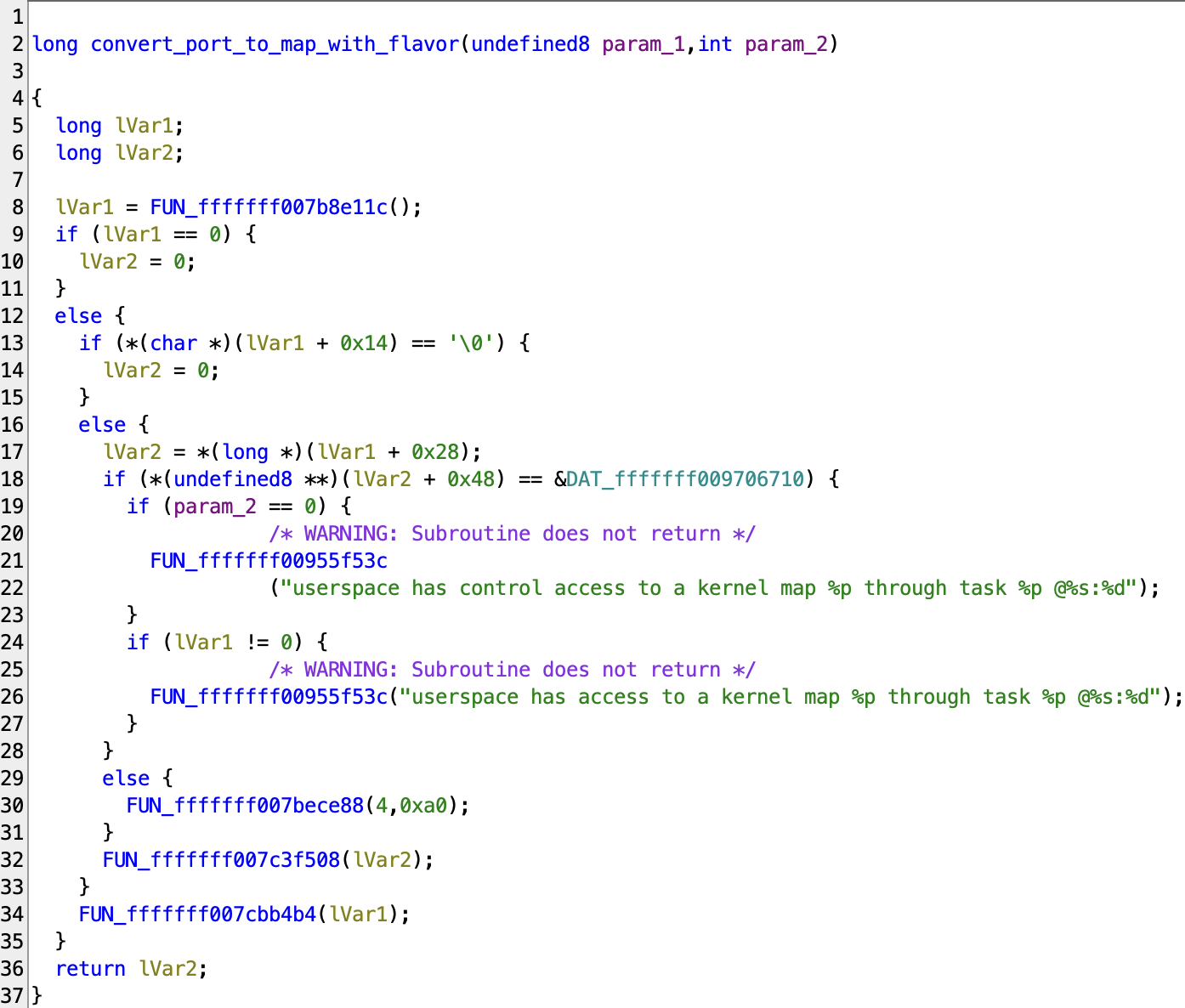
The one that matters most is a send right to an IKOT_TASK_CONTROL port whose ip_kobject is a task whose vm_map covers kernel memory. Hold that and you can call mach_vm_read and mach_vm_write against that memory. That single capability is kernel read/write from userland. It is tfp0. Since iOS 14 the kernel’s own task will not do: convert_port_to_map_with_flavor panics when the resolved map’s pmap is kernel_pmap, which is why a modern chain forges a fake task over a fake vm_map instead.
Make an ipc_port you control read back with io_bits set to IKOT_TASK_CONTROL and ip_kobject pointing at a task you also control, and you have a fake kernel task port even when the real one is out of reach. On arm64e devices (A12 and later) ip_kobject and the entry pointers are PAC-signed (Pointer Authentication: a cryptographic tag stored in a pointer’s unused high bits) with per-field discriminators, so you cannot copy a pointer in from elsewhere. That is a large part of why forging a port is hard today, and it is the subject of the later post on pointer authentication.
ipc_space: a task’s table of capabilities
Ports are the objects. ipc_space is where a task keeps its names for them: the per-task table mapping the names userland sees to the real ipc_port objects. It hangs off the task as itk_space, and it is precisely the Mach counterpart of the file-descriptor table p_fd. Your authority as a task is the set of entries in your ipc_space.
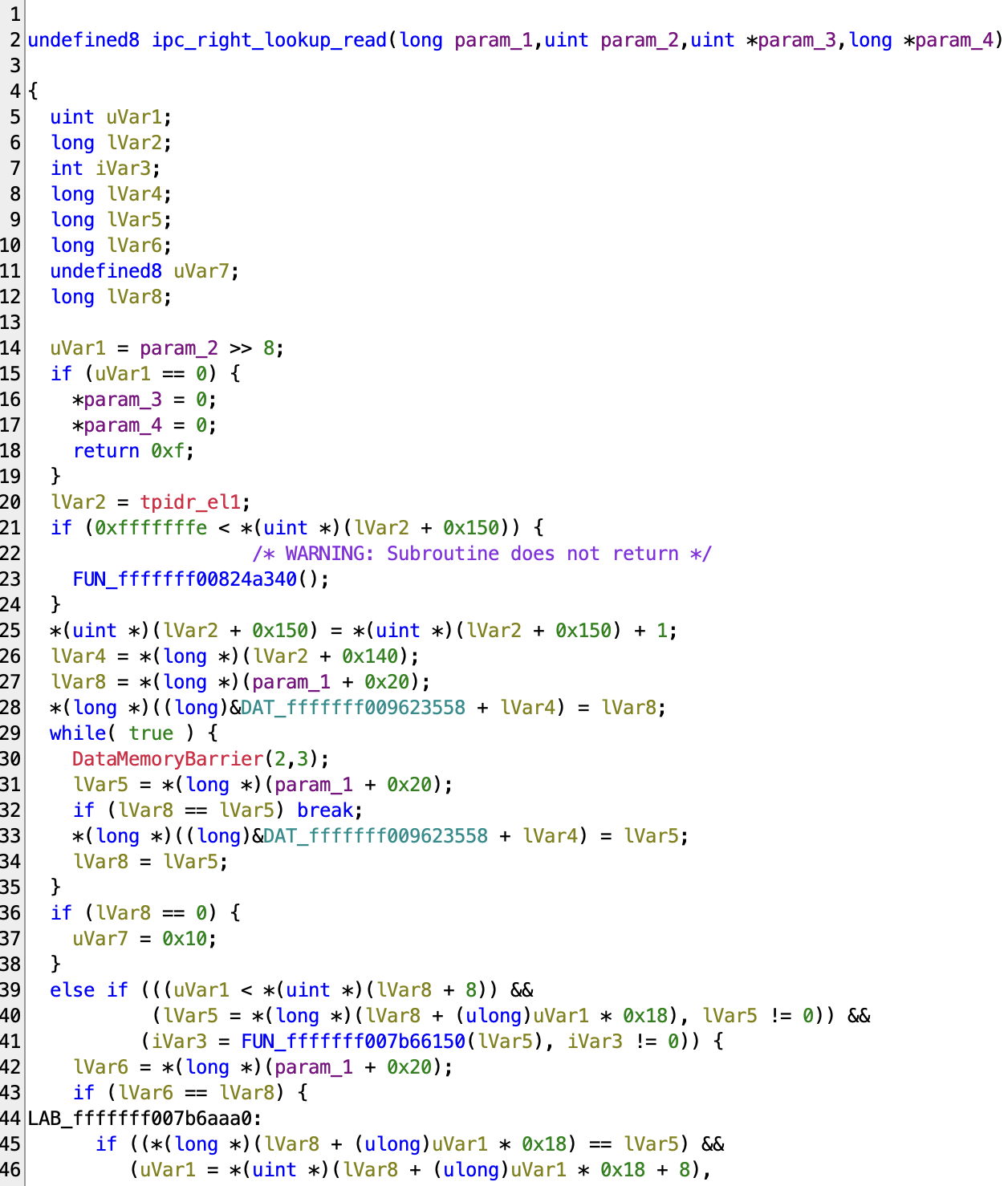
The space holds is_table, an array of struct ipc_entry. A 32-bit port name splits into two parts:
- an index,
MACH_PORT_INDEX(name) = name >> 8, which slot inis_table, - a generation,
MACH_PORT_GEN(name) = (name & 0xff) << 24, a counter used to detect stale names.
Each ipc_entry carries ie_object, a pointer to the ipc_port (PAC-signed on arm64e), and ie_bits, which packs the user-reference count in its low 16 bits (IE_BITS_UREFS_MASK, 0x0000ffff), the right type just above them (IE_BITS_TYPE_MASK, 0x001f0000), and the generation in its top bits (IE_BITS_GEN_MASK, 0xfc000000). Resolving a name is therefore: look up is_table[index], check the name’s generation against the one in ie_bits, check the right type, then dereference ie_object. Every Mach call that takes a port name walks this path, and with a kernel debugger, on a jailbroken device or in Corellium, you can walk the same chain live: task to space to table to entry to port.
When a slot is freed and later reused for a different port, its generation is bumped, so an old name that carried the old generation no longer validates. ipc_entry_lookup() returns IE_NULL on a generation mismatch and the caller turns that into KERN_INVALID_NAME, rather than silently aliasing the new port. Defeating that, by getting a name reused before the generation rolls over or by abusing a table-reallocation bug, is the classic stale port name primitive: an old name resolves to a different port than the one it named, which is capability-level type confusion.
And is_table is an ordinary kernel-heap object whose size and placement an attacker can influence by allocating ports. Corrupting an ie_object pointer means a name now resolves to an ipc_port you control, which is the fake task port again.
Virtual memory, traps, zones, and messages
Virtual memory. Per task, a vm_map holds a sorted set of vm_map_entry ranges, each backed by a vm_object that owns physical pages, with pmap holding the hardware page tables. Two details recur in exploitation: vm_map_copy, the transient object that carries out-of-line message data, is a standard heap-spray and disclosure primitive, and pmap is what the page-table monitors (PPL, then SPTM) exist to protect.
Mach traps are the raw entry points, dispatched through mach_trap_table on negated syscall numbers from EL0. The ones an exploit drives constantly are the _kernelrpc_* port and memory calls (mach_port_allocate, mach_port_insert_right, mach_port_mod_refs, mach_vm_allocate) and mach_msg2, the modern consolidated message path. They are reachable from almost any sandbox, which is what makes them the core surface of nearly every escalation.
Zones are the allocator. zalloc slices pages into fixed-size elements of one kind, with dedicated zones for hot types such as ipc ports. This is where an exploit lines up its objects in memory.
Messages are what flows through ports. mach_msg2 copies a user message into an ipc_kmsg and processes its typed descriptors, port-right transfers and out-of-line memory included. That descriptor handling is one of the densest bug surfaces in the kernel and where the interesting lifetime bugs live, and the dedicated IPC post takes it apart.
The BSD half
The BSD side holds identity, and identity is what you eventually rewrite.
Syscalls dispatch through sysent, indexed by the positive syscall numbers, the BSD counterpart of the Mach trap table.
struct proc is the process from BSD’s point of view: p_pid, the file-descriptor table p_fd, a back-pointer to the task, and p_ucred, the pointer to its credentials (since the iOS 15 and macOS 12 line, reached through the read-only proc_ro structure rather than stored in struct proc itself).
Credentials are a kauth_cred_t, holding the familiar cr_uid and group set plus a field that matters more on iOS than the uid does: cr_label. That label is the slot for the Mandatory Access Control Framework (MACF), the kernel hook layer where AMFI (Apple Mobile File Integrity) and the sandbox attach their per-process policy, and the next two posts are about those two. Credentials are reference-counted and copy-on-write. The offensive use is direct: with kernel read/write, patching your process’s p_ucred to point at the kernel process’s credentials makes you root, and editing the MACF label takes you out of the sandbox and grants entitlements. That was the canonical thing an iOS kernel exploit did with its read/write through iOS 15. Since iOS 16 the credential is read-only memory, which changed the last step of every chain.
VFS, sockets, and kauth round out the surface, and they reach the same heap. The archetype is SockPuppet (Ned Williamson, CVE-2019-8605): a use-after-free in a BSD socket option, exploited entirely with Mach-port heap craft. A BSD bug turned into a Mach primitive.
tfp0: the objective
tfp0 is read “task-for-pid-zero.” task_for_pid(pid) is a Mach trap that returns a send right to that process’s task control port, and pid 0 is kernproc, the kernel’s own process, whose task is kernel_task and whose address space is kernel memory. So task_for_pid(0) once handed you arbitrary kernel read/write from userland, through ordinary, documented Mach APIs. That is where the name comes from.
tfp0 is a capability, not a technique. The bug and the work to exploit it are the technique; tfp0 is the result they produce, the stable kernel read/write primitive expressed as a Mach port.
The name has outlived the trap. On modern iOS task_for_pid(0) never returns the kernel task: the trap checks for pid 0 first and fails before it looks at credentials or entitlements at all. An exploit forges the port instead, exactly as the ports section described: same capability, obtained a different way. So when someone says a chain “gets tfp0,” they mean it reaches userland kernel read/write, not that it called a particular trap.
The APIs are ordinary. mach_vm_read(task, addr, size, ...) reads bytes from a task’s address space and mach_vm_write(task, addr, data, ...) writes them. These are the calls a debugger uses: lldb attaches to a process by taking its task port, then reads and writes the debuggee’s memory with exactly these functions. tfp0 is that mechanism pointed at a task whose address space is kernel memory. Everything comes from which task the port names, a task you were never supposed to be able to name.
Read and write are not interchangeable. A read primitive on its own is reconnaissance: it defeats KASLR (Kernel Address Space Layout Randomization, which shifts where the kernel is loaded) and locates the structures you care about, but it changes nothing. A write on its own is hard to aim: you need a leak, a target at a known offset, or a first write that manufactures the read you were missing. tfp0 is the objective because it packages both, arbitrarily and stably through mach_vm_*, rather than as a fragile one-shot you have to keep re-triggering. Turning a limited primitive into full read/write, upgrading a relative read or a single write-what-where into clean arbitrary access, is a craft of its own and the subject of a later post.
The shape of a kernel exploit
Almost every iOS kernel exploit reads as the same pattern:
- a memory-safety bug gives limited control (an out-of-bounds write, a use-after-free, a refcount error);
- controlled reallocation reclaims the freed or adjacent memory with attacker bytes;
- that memory is type-confused into a kobject port or a disclosable
vm_map_copy; - which yields arbitrary read/write, a userland kernel task port, tfp0;
- which rewrites the process’s credentials and its MACF label, and the process is root and out of its sandbox.
Two historical bugs show the pattern cleanly. Brandon Azad’s voucher_swap (CVE-2019-6225) freed an ipc_voucher through a reference-counting error in MIG (the Mach Interface Generator, which auto-writes the code that unpacks Mach messages for kernel services), reallocated it as a port array, and used the dangling voucher to recover a send right to a fake port, and from there a fake task port. Ian Beer’s “task_t considered harmful” was a design-level capability confusion, where passing task ports across a privilege boundary let a caller confuse which task a kobject port referred to. Both end in the same place: a port that names a kernel object it should not.
State in 2026
The abstractions above are stable; what changed is how hard they are to exploit.
Control ports such as the task self port are now immovable (they cannot be moved to another task) and pinned (they cannot be deallocated), so the old tricks that swapped or freed a task’s own control port fault instead. Reference counts moved to the hardened os_refcnt framework, which panics on overflow and on over-release rather than wrapping, closing the overflow-to-use-after-free class. mach_port_guard lets a holder bind a context to a port so unexpected operations fault.
The endgame moved too. Since the iOS 15 and macOS 12 line, p_ucred sits in the read-only proc_ro structure and struct ucred is allocated ZC_READONLY, through zalloc_ro rather than ordinary zalloc, so patching a credential is no longer a plain kernel write: it needs a gadget that goes through the read-only allocator’s own write path.
Bigger still: kalloc_type (iOS 15) segregates the heap by type signature, so a freed object can only be reclaimed by a type that lands in the same signature bucket, and the bucketing is re-randomized every boot. That breaks the generic “reallocate the freed slot as an ipc_port” move that step 2 above relied on. On A15 and later hardware, from iOS 17 on, SPTM and TXM (the Trusted Execution Monitor) took page tables and code signing out of XNU entirely, so even a full kernel read/write can no longer rewrite page tables or forge a code-signing verdict. On A19, Memory Integrity Enforcement (always-on hardware memory tagging) makes many linear overflows and use-after-frees crash on the spot instead of corrupting anything. tfp0 is now the start of the hard part.
Hands-on: reading the structures out of the kernelcache
The previous post pulled a kernelcache apart the long way, through the Image4 container. To just get one open in a disassembler, ipsw downloads and decompresses it in a single command, without fetching the whole IPSW firmware bundle:
ipsw download ipsw --device iPhone10,3 --version 15.0 --kernel
# writes a decompressed arm64 Mach-O under a build-named folder, e.g.
# 19A346__iPhone10,3/kernelcache.release.iPhone10,3_6

file 19A346__iPhone10,3/kernelcache.release.iPhone10,3_6
# Mach-O 64-bit executable arm64
iPhone10,3 is an A11, so this image is plain arm64, not arm64e, and the pointer fields you will see are not PAC-signed. That is what you want for a first read: the raw layout, without the signing A12 and later add on top.
Open the file in a disassembler with arm64 support: Hopper, Ghidra, or IDA Pro on macOS. IDA Home works as well, but it licenses one processor family at a time, so you need the ARM edition, and it ships without the decompiler. Point it at the whole kernelcache, kernel plus all kexts, and let the analysis finish.
A release kernelcache carries almost no symbol names, so recover them first. ipsw kernel sym, paired with blacktop’s symbolicator signatures, rebuilds most of them and writes a JSON you apply with the matching script for Ghidra, IDA Pro, or Binary Ninja. IDA users can additionally run ida_kernelcache, the maintained cellebrite-labs fork of Azad’s original, to rebuild the C++ vtables and OSMetaClass hierarchies.
Work through four things:
1. The syscall tables. mach_trap_table and sysent both sit at the front of the kernel. ipsw dumps the BSD one in full, each entry with its number, handler, argument count, and C prototype:
ipsw kernel syscall kernelcache.release.iPhone10,3_6
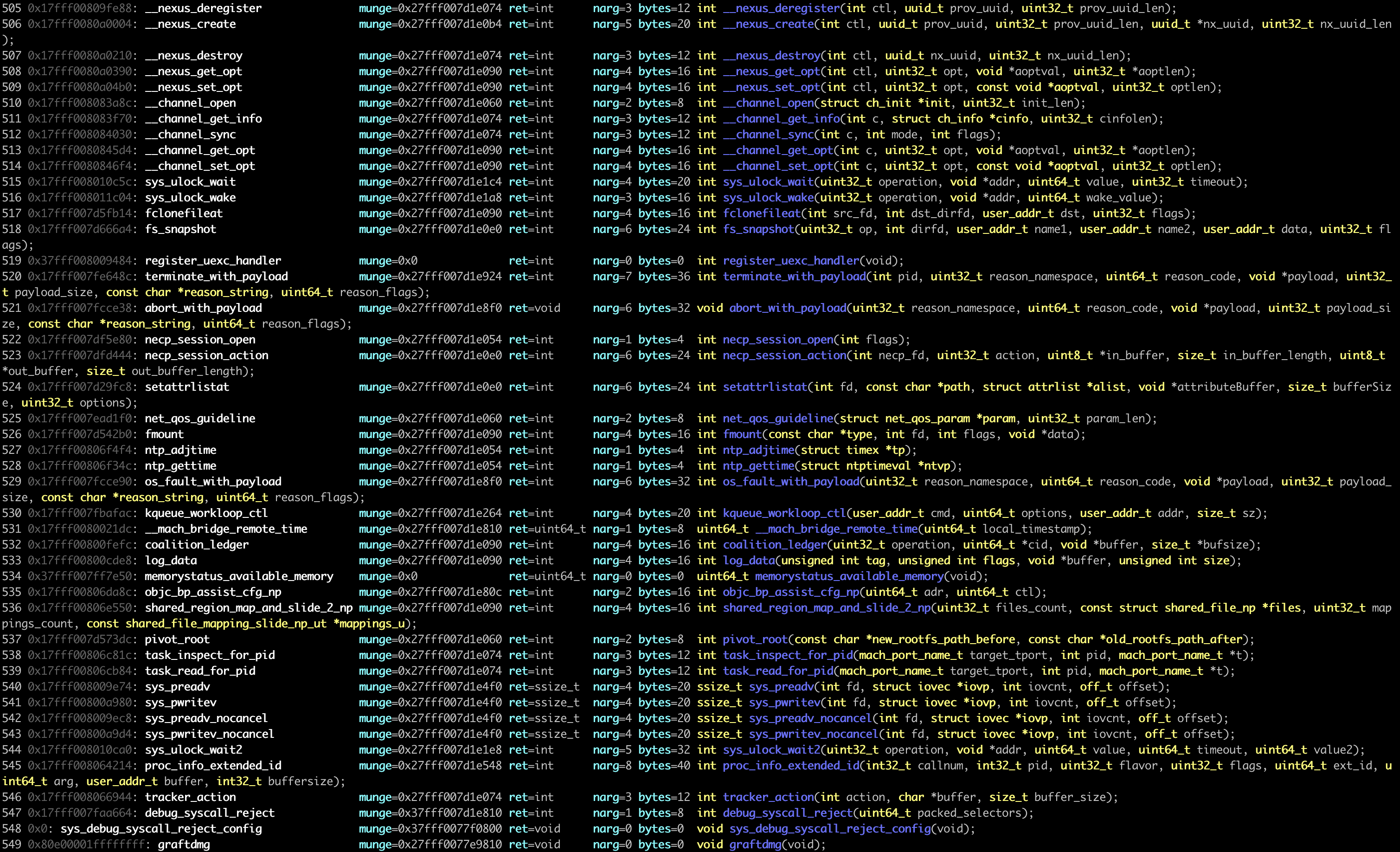
In the disassembler mach_trap_table sits at its symbol as a raw array of { argument count, handler pointer } entries.
2. Port to kernel object. Decompile any member of the convert_port_to_* family; convert_port_to_map_with_flavor is a clean one. Its own body is the tail of the bridge, since the port-to-task translation and the kobject type check sit in the callee it opens with: it takes the task behind the port, checks the task is still active, walks to task->map, and compares map->pmap against kernel_pmap. When that comparison hits it panics with userspace has access to a kernel map ... through task. That is the iOS 14 check from the ports section, in the binary.
3. The name lookup. Decompile ipc_right_lookup_read, which resolves a port name for a read. The ipc_space walk is right there in the decompilation: param_2 >> 8 for the table index, * 0x18 to scale it by the ipc_entry size, then ie_object at offset 0 and ie_bits at + 8.
4. Where identity lives. The last piece is the write target. struct proc holds p_ucred, and the kauth_cred_* accessors that symbolication turns up read the very cr_uid and cr_label fields a chain overwrites at the end: patch p_ucred to a privileged cred and the process is root and out of its sandbox. On this iOS 15 image that is a plain kernel write; from iOS 16 the same fields sit in read-only zones.
Where this leaves us
XNU is a Mach and BSD hybrid in one address space; authority is held as ports and named through ipc_space; and the objective every escalation shares is a single capability, tfp0, a userland handle to kernel read/write that you obtain today by forging the kernel task port rather than by asking for it.
That capability is only interesting because of what it is allowed to overwrite, and the next posts are about what sets those limits. The MACF label we just met inside p_ucred is where the following article starts: the framework that decides, at every exec, what is even allowed to run, and how AMFI, code signing, and trust caches hang off it.
Notes and sources
Everything here is drawn from open source, vendor documentation, and published research.
- Apple’s open-source XNU is ground truth for every structure and macro named above:
osfmk/ipc/ipc_port.h,ipc_object.h,ipc_entry.h,osfmk/mach/port.h(MACH_PORT_INDEXandMACH_PORT_GEN),osfmk/kern/syscall_sw.c(the trap table),osfmk/kern/ipc_tt.c(theconvert_port_to_*helpers),osfmk/kern/ipc_kobject.c(the manual PAC ofip_kobject), andosfmk/kern/kalloc.c/zalloc.c. - Jonathan Levin, *OS Internals, Volume II: Kernel Mode (newosxbook.com), is the reference for the Mach and BSD structures, trap tables, and zone allocator.
- Brandon Azad, “voucher_swap: Exploiting MIG reference counting in iOS 12” (Project Zero, CVE-2019-6225), and “A survey of recent iOS kernel exploits” map the port and zone primitives named here.
- Ian Beer, “task_t considered harmful” (Project Zero), is the capability-confusion case study, and the
mach_portal/async_wakewriteups established the port-spray playbook. - Apple Security Research, “Towards the next generation of XNU memory safety: kalloc_type”, for the heap-segregation change that reshaped step 2 of the exploit arc.